Give me a sec to dump my hefty dice bag, throw off this dusty cloak, and kick up my feet up onto the bar.
Whew. Alright, I’m back from another month of dungeon mastering (DMing) for my two Dungeons & Dragons (D&D) campaigns. I’ve fresh tales to share with all of you, along with some neat storytelling tricks I’ve learned along the way — all thanks to the chaos, depth, and dauntless imaginations of my players.
If you missed last month’s tales, you can read it here: How Dungeon Mastering Makes You a Better Writer (vol.1).
#6 A deeply flawed character is a gift that keeps on giving
As a DM, I’m responsible for creating the stories that affect my players. I’ve found that the easiest characters to create content for are those with backgrounds full of what are called “daggers.” Daggers are unresolved problems from a character’s backstory (think: debts owed, a wronged archnemesis, a warrant out for their arrest, etc.).
As a DM, I love daggers, because at the most inopportune time, I can complicate the story for my players and raise the stakes. In my Greyloss campaign, the zealous celestial warlock, Uriel, handed me a backstory where his holy deva demanded that he murder the youngest daughter of a wealthy patron at Uriel’s church. Without question or doubt, he did as he was told.
This “dagger” alone led to me creating a complex story arc, which involved Uriel dedicating himself to a new and mysterious god who is determined to destroy the religion Uriel grew up in. This resulted in Uriel turning on his church and working to bring down the religion of his father, who is one of the highest priests in the land. Fast forward to our current arc: Uriel’s adopted brother is out to murder him while they both compete in the queen’s tournament, and the folks of Greyloss are not keen on this heretic who’s been tearing down their sacred god.
To survive the tournament, Uriel will not only have to evade his own family’s murderous zealotry but also the laypeople’s stubborn faith.
Writing Lesson Learned: Boring people do not fill the pages of books. You’ll never pick a memoir about someone with a serene, trouble-free life, nor an epic fantasy where the hobbit never leaves the Shire. That’s why the more you laden a character’s backstory with “daggers,” the more story you’ll wind up getting later. Any character running from their past mistakes and misfortunes has a bright future ahead of them in becoming terribly interesting.
#7 Up the stakes by making the villains annoyingly proactive
The best story arcs I’ve DM’d are where the villains are constantly one step ahead of the players. They’re literally ahead of them on the map, laying traps, crafting illusions, and throwing up obstacles in their path.
In InSpectres, one of the players had their evil badass warlock, Zaz, leave the party after a falling out (the player then swapped to playing a warforged sigilsmith). Zaz went on to join a rival adventuring group, called the “Evershadows,” which included the ex of the party’s professorial artificer, Coswallop.
The Evershadows and the Inspectres both were trapped in the Weirderness, where the fundamentals of magic were broken, and extradimensional beings were wandering the lands. For one encounter, I wanted the party to fall prey to one of the Evershadows’ tricks.
The party was in hot pursuit of the Evershadows, following their tracks through a snowed-in canyon. I had the Evershadows intentionally lead their footprints into a magical monolith/gateway (but in reality, they had used misty step to teleport behind it instead). The party followed those tracks to the gateway and assumed the Evershadows had passed through.
The party entered into a pocket dimension with an extradimensional god named Hazuroot. To better understand the world, Hazuroot demanded each member of the party give up one of the following:
| D12 | Hazuroot takes…. |
| 1 | Voice |
| 2 | Sight |
| 3 | Coins |
| 4 | Empathy (alignment: evil) |
| 5 | Sense of humor |
| 6 | Magic item |
| 7 | Pain receptors |
| 8 | Last month of memories |
| 9 | A language you know |
| 10 | Sense of shame |
| 11 | A skill you know |
| 12 | Hearing |
The players lost memories of love, horn proficiency, Sylvan (language), love of beer and the ability to make it, simple weapon proficiency, and the ability to feel pain and shame. Hazuroot then released them back into the Weirderness.
Needless to say, the party was extra motivated to hunt down the Evershadows after this little trick.
Writing Lesson Learned: Static antagonists make for flat stories. Complex stories with rising stakes rely on a chessboard back-and-forth between the main characters and the antagonists, where each is responding to the moves of the other. A proactive antagonist will not only respond but anticipate its foe’s next move.
#8 Be short but punchy with descriptors
Like reading, D&D relies heavily on the theater of the mind to immerse participants. And nothing makes the collective eyes at my D&D tables glaze over than when I spend more than 20 seconds setting the scene.
After making this mistake a few times, I realized that painting the entire picture was far less important than establishing the immediate, most visceral vibes. Because when you first walk into a new place, you don’t absorb every piece of furniture, artwork, or rock feature. No, you first scan for immediate threats, be it people, monsters, terrain, obstacles, or weather. You clock how your body is responding to the environment before stepping forward.
Now when I establish scenes in D&D, I focus on delivering 2-3 key details that elicit the dominant mood of the place. For example:
The Weirderness: Velvety snow sludges down the sun-warmed rocks. A strange iridescence glows along every surface here as if everything’s coated in a film of oil. Overhead, fractured and torn rainbows crisscross the sky.
A hag’s indoor bathhouse: Fireflies skim the hot spring waters, and robes sewn from moss and lichen hang off hooks. A darkness permeates the bath, making it impossible to see below the lily pads. A sleepy warmth seeps deep into your bones.
A demon lord’s sex/murder temple: Crimson velvet swallows the walls and ceilings of the Lord’s opulent hall. The longer you gaze upon the velvet, the more it resembles bloodied flesh with flashes of bone. Perfumes, heavy with the musk of pheromones, mask the tangy wafts of blood.
Writing Lesson Learned: Instead of trying to capture everything, focus on which details create a vivid first impression. What hits the body’s senses first? The lighting? The smells? The temperature? A few key details hit harder and last longer than a wall of detailed description.
#9 Not show, not tell, but a secret third thing
In D&D, a key expectation of the DM is to give out quests for the players to complete. Often, non-player characters (NPC) will ask the party to do something in exchange for a reward. However, this often feels video gamey and ham-fisted to me, so I try to craft quests in ways that feel natural.
Doing this takes a bit of setup. I have to put all the right ingredients into the kitchen and let the players cook. In other words, the best quests are the ones that the players have decided themselves to take on and become proactive about. They figure out what the goal should be and break down what they need to accomplish it.
For example, in InSpectres, I had the players come across a depressed widower named Simone Applesoil, who was living by herself on a large farm. In talking with Simone, the players learned that her husband was murdered a year ago, and the killer had never been caught. Strangely, on the day he was murdered, Simone’s husband told her that her father was sick. Simone had left to pay her father a visit, discovered that he was perfectly well, and it was only when she returned home that she found her husband dead.
Instead of having Simone directly ask the players to solve the mystery of her husband’s death in exchange for a reward, I set the scene: a farm falling into disrepair because a depressed widower could not move on past her husband’s unsolved murder. The players could have ignored her and moved on, but instead, they decided that they would solve the murder mystery.
To do so, they knew they needed to look for clues, including a suspect and a motive. To help them piece together the mystery, I had Simone talk offhandedly about how the town’s mayor often would check on her. She implied that she had difficulty in getting him to leave whenever he would drop by, and that he offered generous amounts of money to buy the farm from her. She always declined, because she felt like she would then “owe” him, which didn’t sit right with her.
The players decided to check in on the mayor, and in the process, they discovered articles of Simone’s clothing in his house. They used speak with dead to question the dead husband and learned that he had discovered the mayor stealing his wife’s clothes and stalking her. The husband had tried to catch the mayor in the act but was murdered in the process.
Once the players solved the murder, they decided that Simone deserved justice. They set up a courtroom and put the mayor on trial. The party’s law-minded sigilsmith found him guilty, and they surrendered him to the town’s fox goddess for punishment. In thanks, the town and its goddess bestowed them with food, hospitality, and divine blessings.
Writing Lesson Learned: Seldom does writing advice teach about the murky middle between “show, don’t tell.” Too much telling feels on the nose, and too much showing can confuse and bog down the story. Sometimes what a writer needs to do is telegraph. In other words, put enough pieces down on the page that the reader can naturally infer the next step without it needing to be explicitly told or shown.
#10 The secret trick to fast and dirty characterization
As a DM, I often have to invent NPCs on the fly (and pluck names out of thin air, ugh). The fast and dirty way to create a character that feels three-dimensional is for me to figure out two things quickly (1) what does this character want in this moment, and (2) what is their dominant flaw as a person (e.g., greedy/nosy/stubborn). Nine times of 10 this creates immediate and memorable friction for the interaction.
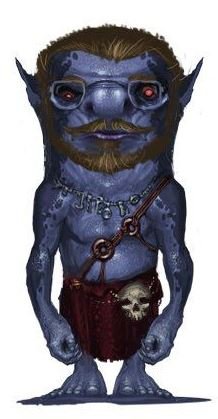
Take for example Xannie. Xannie was supposed to be a throwaway character that I had created on the spot to help the party through a quest. He had been exiled from his xvart community for being uglier than everyone else (xvarts are identical lookalikes of their god, Raxivort). All he wanted was to leave the wilderness and start a new life away from Raxivort’s overbearing influence. Xannie’s dominant flaw, however, was that he loved to hustle everyone and everything.
To my shock, the party ended up rescuing Xannie from his predicament. They even tolerated his presence after he took over a magical item shop under suspicious circumstances. To thank the players for their help in rescuing him, Xannie offered them discounted magical items. Since then, he’s become the main merchant to the party.
Writing Lesson Learned: Ancillary characters provide texture to stories by exerting their presence even in small moments. They have their own needs/wants and are proactive in obtaining them. Think of the lonely cashier who chats your ear off despite the crowded check-out lane, or the erratic bus driver who’s skipping bus stops because he’s running late. The strangers you remember throughout your day are usually the ones who’ve brought friction to your interaction or who have evoked some emotion in you. For writers, you can bring that same energy into your stories by sketching a character’s immediate need and pairing it with the flawed way he or she sates that need.