
Back in 2017, I launched my first Dungeons & Dragons (D&D) campaign called The Crepusculum. It was an electric, addicting, anxiety-fueled rush serving as the dungeon master (DM). No matter how much you prepare for your games, you’ll find yourself forced to improvise as your players breeze past the quest givers, unveil the Big Bad Evil Guy far too early, and murderize the goblin merchants who were selling a very important MacGuffin (*cough* Craig).
A decade later, I’m still dungeon mastering (“DMing”) two campaigns: Greyloss (a political intrigue involving fey courts and otherworldly monstrosities) and InSpectres (an episodic adventure where players investigate weird and forbidden mysteries). In that time, I’ve been shocked by how much DMing is like a writers’ boot camp, where your characters are alive, have a mind of their own, and will totally derail your precious plot. To survive, you have to master the raw elements of storytelling and be able to change them on the fly.
Along the way, I’ve learned 10 lessons that have sharpened my own writing. Because this is a little long, I’m sharing five of those today with the second part coming next month.
#1 Characters are uncontrollable chaos gremlins, and that’s a good thing
Everyone knows that you’re not playing your character right if you don’t make your DM bury their face in their hands at least once a session. As a player, you have an obligation — nay, a sacred duty — to insert as much chaos into your DM’s meticulously crafted world as feasibly possible. Dominos must be kicked over. Invisible glass barriers must be shattered. Societal orders must be shaken up for their own good.
My players love getting deep with their characters. They eschew making the “best” choice (i.e., not taking damage / avoiding consequences) in favor of sticking with what their characters would actually do.
In Greyloss, the party’s (paladin-coded) Aasimar warlock, Uriel, grabbed a young child and began punching her in front of a group of shocked NPCs (non-player characters, which are run by me, the DM). Now, of course this sounds horrible and awful and would surely ruin Uriel’s holy-man reputation.
But Uriel had a reason: a hag had body-swapped the young girl with a violent, predatory nobleman. That meant inside of this “child” was the soul of one of the party’s archnemeses. The nobleman had been leaning into his “little girl” persona to seemingly place the party into danger just moments before. And Uriel was the type to met out justice, regardless of how it appeared to outsiders.
In InSpectres, our naive-to-the-world warforged sigilsmith, Aleph, visited a fantasy version of Burning Man and taught himself what, ahem, “intercourse” was by purchasing the festival’s most expensive “sex pass.” Did I plan for that? No. Did I roll with it? Yes, and it got very weird very fast. This culminated in the party requesting a fetish tent filled with centipedes, scorpions, and other creepy crawlers, which was shockingly relevant to their quest of finding their missing demon beetle. They managed to score a lead all because their naive warforged decided to educate himself on the ways of the world.
Writing Lesson Learned: Proactive characters generate plot. They are the flap of the butterfly wing that results in hurricanes. If you create a deeply realized character, you can set them loose, and they will go on to tell a whole story.
#2 Dirty DM prep distills story into its most raw components
To my players reading this: look away for a moment.
When I first started DMing, I would spend 10+ hours prepping content, maps, tokens/miniatures, reference cards, artwork, music, and more for a single session. Nowadays? I often skip 99% of the prep, drink a little wine, and wing the whole session. I’ve been known to read over a monster’s stat block while a player is in the middle of telling me about their turn. (For the players who’ve ignored my prior instruction: Don’t worry, I’ve never done this in our game.)
This (somehow) manages to be successful because of that 1% of effort I do religiously expend before every game. In fact, I’ve done it enough that I’ve developed a formula for it: map + antagonist’s goal = player’s obstacle. As long as I have those three elements, I can almost always improvise a 3-to-4-hour game.
Maps. The map itself does heavy lifting. It sets the mood, weather, lighting, terrain (and all its natural challenges), and dictates the players’ physical movements.
Now, I will confess this has backfired on me before with hilarious results. I often pull from Czepeku, who creates gorgeous maps brimming with details and Easter eggs. One time in InSpectres, our resident firbolg ranger, Fenrick, noticed the map was teeming with tiny lizards, frogs, and salamanders that I hadn’t noticed. Fenrick used speak with animals to speak with a lizard. In a panic, I said the lizard was upset because he couldn’t find a mate due to all the other critters being illusions (in truth, I knew the players would want to talk to every single critter on the map, and I wasn’t in the mood to voice them all that day).
So of freaking course, Fenrick and the rest of the party had a new quest: find this lizard a real, live lizard girlfriend. This ultimately culminated in the lizard and the party’s swole half-orc doing a push-up contest before a lady lizard they found later. (And yes, the two lizards then lived happily ever after.)
Antagonist’s goal. Whenever I put an NPC on a map, I try to figure out what they want. It doesn’t have to necessarily be a massive diabolical plan of ensnaring the players and hanging them above a pit of lava. Sometimes it’s simpler than that. And sometimes that results in the most deliciously convoluted D&D sessions.
For example, in a recent Greyloss session, the playboy bard satyr (Ryn) ran into his four exes simultaneously. These exes happened to be fey manifestations of the four seasons. The 3-hour-long session was run entirely off of a fairy-ring map and these four notes:
Spring: You promised to marry me!
Summer: You owe me money for your gown.
Fall: We have a CHILD.
Winter: Wants to kill Ryn for their oh-so-nasty breakup
Player’s obstacle. With maps and motivations in hand, it’s easy to then formulate what the players’ obstacle will be for the scene. In Ryn’s case, it became: None of you are getting into the Summer Court’s party until you mop up Ryn’s past troubles. (For those curious, Ryn and the party resolved those four quandaries by 1) Ryn magically compelling the werebear NPC to seduce Spring; 2) having the party’s “dad” (Doren) pay all of Ryn’s debts; 3) having the party’s “dad” promise to be the child’s tutor; 4) placating Winter until Ryn figures out what to do next.)
Writing Lesson Learned: Anyone can become a pro pantser so long as they know what the scene’s core elements are: where are we + what does everyone want right now = voila, you have your protagonist’s main conflict. Everything else you can make up on the fly.
#3 Curveballs forced this plotter to become a pantser
Back when I was a newbie DM who over-plotted and over-prepared for every session, I tried to anticipate every single thing my players might do in a given game. I was terrified of what would happen if they ventured into uncharted territory or upended the storyline in some catastrophic way. At the time, I didn’t recognize this for what it was: perfectionism (a particular Achilles’s heel of mine, which I’ve blogged about before: How To Strong Arm Your Way Past Perfectionism).
But every DM must learn the sacred rule: Your players will catch you wildly off-guard at some point. And you gotta get cool with that real fast.
Let me tell you a little story about the Crepusculum campaign. I had spent a week hand-drawing an elaborate map of a druid village set high in the forest’s canopy. I carefully devised how I would funnel the players through each hut and across every swinging bridge, ensuring they’d be challenged but never overrun. These well-balanced fights were meant to wear the party down as they progressed through a gauntlet of drug-addicted druids towards the Big Bad Evil Druid’s residence.
At first, the party proceeded as I had predicted: methodical, careful, stealthily picking off druids. Then entered Galen, the party’s knowledge cleric / lore bard.
Galen sprung ahead, pretended to be a druid named “Legoblok,” and cast suggestion on one of the druids, forcing her to walk and talk with him. He disappeared ahead into the village with the charmed druid in tow, intent on waltzing straight to the Big Bad Evil Druid’s hut. Along the way, he poisoned a bag of drugs and handed out hits of it to the druids he passed.
Above game, I grew increasingly worried how this would turn out. I never would have thought the team’s healer would brazenly forge ahead on his own, charming his way into the depths of the viper’s nest. Worse, the dice were not falling in Galen’s favor, and the druids were become increasingly suspicious of him as they fell ill to his tainted drugs. Meanwhile, my thoughts raced: He’s about to aggro the entire druid village and wipe the party. This could wind up ending my campaign!
In that moment I was forced to make a decision: Do I railroad the party to save them from almost certain death? Or do I keep improvising and let the dice fall as they may?
I decided to take the latter route, because I hate railroading players. I was also curious to see how this would work out for poor Galen.
As the ruse unraveled, Galen cast puppet on the druid and walked her off one of the high bridges. On the way down, she threw a fireball at Galen, outing him to the whole village. As expected, Galen ended up attracting the attention of the entire gauntlet of druids.
The party then spent the next eight hours fighting the hordes of druids pouring down upon them. And I spent those eight hours having to improvise the entire battle.
After that, I realized the worst hadn’t come to pass. The party handled the onslaught well, and I managed the chaotic scene just fine. After that point, I recognized that I didn’t need to have such a death grip on my story prep going forward; I could trust myself to handle the chaos as it came.
Writing Lesson Learned: You can’t plot/plan for everything. Some of the best stories come out of just winging it (I say as all the pantsers collectively go, “NUH-UH.”)
#4 The hardest challenge of all is puzzles for toddlers
There’s a running joke in my InSpectres campaign that if I give them puzzles, they have to be puzzles for toddlers. That’s despite Thokk, the half-orc barbarian himbo, solving a tricky puzzle — one that took my Greyloss players over an hour and several hints to get — in under 10 seconds. (I’ll get to that puzzle in a moment.)
All of my players are exceptionally bright people who frequently triumph over escape rooms, crush NYT puzzles, and breeze through games like Baldur’s Gate 3. Despite that, the adage “you don’t know what you don’t know” will forever hold true for both D&D players and fiction readers.
That’s why, whenever I put a mystery or a puzzle into a D&D game nowadays, I litter the scene with clues and hint-givers, along with a red herring or two. I’ve had to ingrain that, what’s obvious to me as the omniscient DM, will never be obvious to a group of players when it’s shown (not told) inside of a story.
Let me reveal why. I gave the same puzzle to both the Greyloss and the InSpectres players. For the Greyloss group, they were working their way through a hag’s maze-like cottage and were trapped inside of a swamp room that was filling with noxious gas. There was a magical doorway, where critters (like rabbits, butterflies, and grasshoppers) were passing through with ease, but the doorway rebuffed the players. They successfully tossed a wooden log through the doorway but not a crocodile.
When I described this same setup to the InSpectres group, Thokk wrote down a list of everything that could pass through and immediately saw the pattern: only creatures and things with names that have double letters (“rabbit”; “butterflies”; “grasshopper”) were allowed through the magical portal. It’s only because the player wrote down what was being shown that she was able to so quickly deduce the gimmick.
Writing Lesson Learned: Never be afraid to foreshadow and seed clues throughout a story. What might be obvious to you as a writer will not be obvious to the reader unless you (1) spell it out or (2) give them enough dots that they’ll eventually see the line.
#5 Environments make for some of the best antagonists
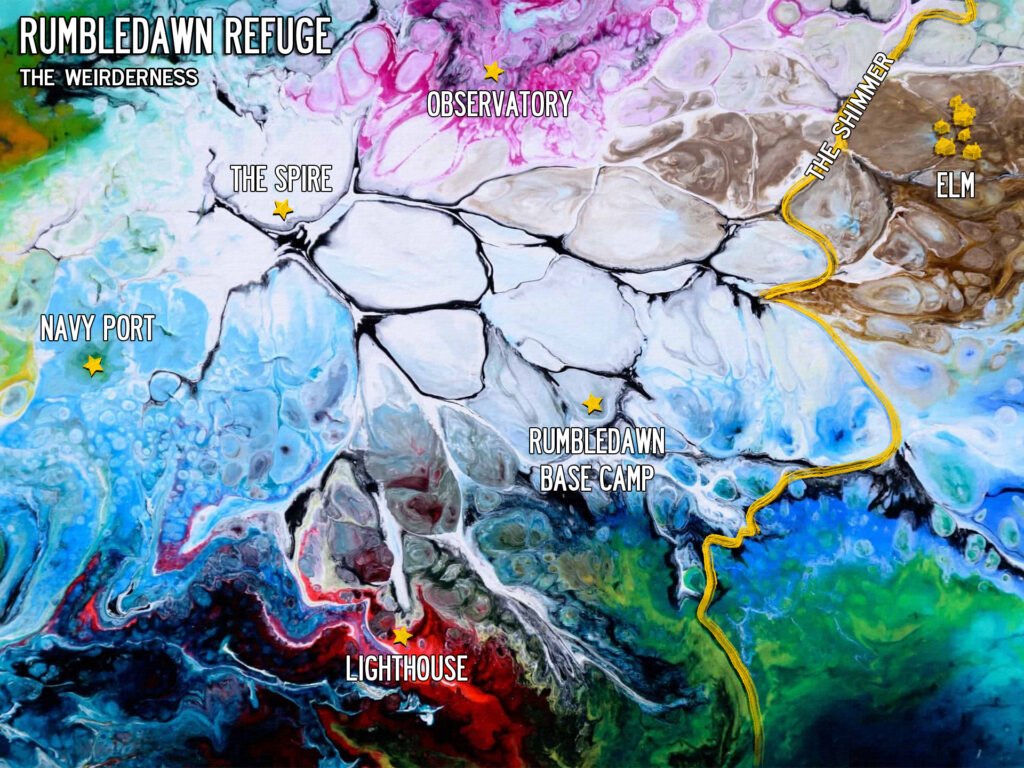
In one InSpectres storyline, I took inspiration from Jeff Vandermeer’s Annihilation and created a snowy tundra called the “Weirderness.” The Weirderness is a focal point of the Great Syzygy, a cosmic event where all the planes of the D&D universe line up and unravel the basic fabric of reality. The longer the players are in the Weirderness, the more insane they become. To help the party survive, an NPC gave each player a secret role that seemed suspicious but was actually critical to the group’s success.
One player was responsible for wiping the memories of anyone who came across a chwinga (an elemental spirit whose presence needed to remain hidden). Another player was responsible for identifying players whom the chwingas had replaced with clones (unbeknownst to even the player) and secretly killing that player’s cloned character away from everyone else.
This all took place in a freezing arctic environment, where the snow would turn into bismuth in the wake of roaming Titans, and where the Aurora Borealis was actually sky jellyfish who’d mesmerize you until you froze to death. On top of it, the players were on a time crunch, had a rival party undermining them, and were never quite sure if they could trust each other. To date, the Weirderness has been the most stressful story arc I’ve run across all my games (well, stressful for my players; I had a great time).
Writing Lesson Learned: In my opinion, environments are one of the most underrated and underutilized antagonists in fiction. We often regulate them to survival stories and sci-fi, but the milieu can be a goldmine for almost any storyteller. In my (currently unpublished) sci-fi novel, All Is Well, the two major landscapes — a hyper arid flatland and a possibly toxic paradise — are major antagonists in themselves and are at the heart of the story’s conflict.
That’s all for now! Next month, I’ll share five more lessons, including the favorite flaws my players have adapted for their characters.
Trackbacks and Pingbacks